IFJ Centenary Celebration

The IFJ Centenary Celebration will be a significant event for journalists and media professionals worldwide. The congress will be held at Novotel Paris Est, Porte de Bagnolet, from May 5th to 7th, 2026. The theme of the congress will be ‘100 years of international solidarity for strong journalism and trade unionism’. This event will serve as a strategic forum for shaping the future of journalism and electing the IFJ’s new leadership for the next three years. The congress will also highlight the crucial role of unions in protecting jobs, promoting ethical journalism, and ensuring a sustainable future for the profession. 


Independence Day -2026

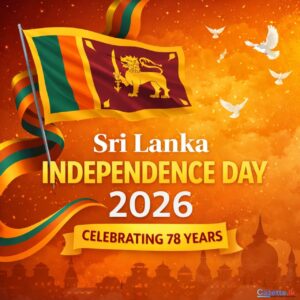
Sri Lanka Independence Day is one of the most important national days in the country. Celebrated every year on February 4, it marks the day Sri Lanka regained its freedom from British colonial rule. In 2026, the nation proudly celebrates 78 years of independence, honoring the sacrifices, struggles, and unity that shaped the country’s journey to sovereignty.

On this day, Sri Lankans remember the leaders, freedom fighters, and communities who worked tirelessly to achieve self-rule after more than 400 years of foreign colonial influence.

Exposition of the Holy Devnimori Relics

The Exposition of the Holy Devnimori Relics of Lord Buddha from Gujarat, India was inaugurated by H.E. President Anura Kumara Dissanayaka from the Sri Lankan side and Governor of Gujarat Shri Acharya Devvrat, and Deputy Chief Minister of Gujarat Shri Harsh Sanghavi from the Indian side in the presence of Chief Incumbent Ven. Dr. Kirinde Assaji Thero at the Gangaramaya Temple, Colombo on February 04, 2026. Hon. (Dr.) Hiniduma Sunil Senevi, Minister of Buddhasasana, Religious and Cultural Affairs, Hon. (Dr.) Nalinda Jayatissa, Minister of Health & Mass Media, and Hon. (Prof.) A.H.M.H. Abayarathna, Minister of Public Administration, Provincial Councils and Local Government were also present. The Exposition will be open for public veneration from February 05, 2026 onwards.


    The Exposition follows the announcement made by Prime Minister Shri Narendra Modi during his State Visit to Sri Lanka in April 2025. It reflects the deep-rooted spiritual and civilisational ties between India and Sri Lanka.   The arrival of the Holy Relics on February 04, 2026, coinciding with Sri Lanka’s 78th Independence Day, added special significance to the occasion. The Exposition is the first public veneration of the relics outside India. India had earlier organized the Exposition of Kapilavastu Relics in 2012; and Sarnath Relics in 2018, in Sri Lanka.


    Devnimori, located in Gujarat, India, is an important Buddhist archaeological site where excavations uncovered a Sharira Stupa containing relic caskets with sacred ashes, a copper box, and gold and silver foil. One casket bears an inscription in Brahmi script and Sanskrit reading “DashabalaShariraNilaya” — “the abode of the bodily relic of Lord Buddha” — making these Relics among the most significant Buddhist archaeological discoveries in India.

Syria- Improving the safety of journalists reporting in the field

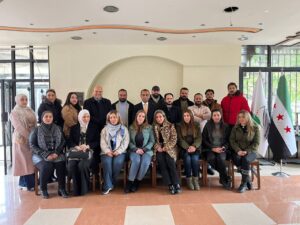
Journalists’ safety matters. As part of our ‘Safety of Journalists in the Middle East and the Arab World’ project, we delivered two training sessions on occupational safety in Damascus and Latakia in January. Focusing on building professional capacity and promoting safer working practices in the field, the sessions were organised in partnership with our affiliate, the Syrian Journalists’ Union (SJU).

Building stronger unions and safer newsrooms in Karachi

January was a busy month for activities in Karachi! As part of the ‘Strengthening Union Communications and Digital Advocacy’ project under the IFJ-National Endowment for Democracy‘s ‘Promoting Labour Rights and Gender Equality in Pakistan’s Media’ initiative, the Karachi Union of Journalists (KUJ) launched several awareness campaigns. These campaigns focused on key issues including the role of unions and press clubs, the importance of membership fees and fundraising, labour laws and the rights of media workers, the right to decent work and fair wages, and the need for safer workplaces for journalists. IFJ reports

The Centenary of Broadcasting in Sri Lanka (1925-2025)

The Broadcasting began on an experimental basis by the colonial Telegraph Department in Ceylon (now Sri Lanka). The first broadcast featured gramophone music, with a transmitter built using salvaged radio equipment from a captured German submarine. The regular broadcasting service, initially called Colombo Radio, was launched on December 16, 1925. This made it the first radio station in Asia and second oldest in the world. Edward Harper, the Chief Engineer at the Telegraph Department, is often called the “Father of Broadcasting in Ceylon”.The , then British Governor Sir Hugh Clifford inaugurated the broadcasting services in Sri Lanka.
It was first known as Ceylon Radio. In 1943 broadcast station premises were shifted from Torrington to a bungalow named Bower in Cotta Road Boralla due to the second World War. During World War II, Radio played a critically important, strategic, and morale-boosting role in Sri Lanka during, primarily through the operation of Radio SEAC (South East Asia Command).The station was taken over by the Allied Forces and operated from Ekala – broadcasting news and programs to Allied forces across South and Southeast Asia led by Admiral Lord Louis Mountbatten. The local radio station was taken over to serve the command’s military and propaganda needs.
The Bower ceased broadcast by midnight of December 30th ,1949.The name changed to Radio Ceylon and the station shifted to from Torrington Square on January 1 st,1950.
The Clifford R Dodd, Australian administrator is regarded as the “father of the commercial broadcasting” in Ceylon, the Commercial Service was launched in 1950. This service became immensely popular, particularly its Hindi Service, which played film songs that were often restricted by All India Radio (AIR). The iconic Binaca Geetmala program was a major hit across the Indian subcontinent.This period is considered the “Golden Era” when Radio Ceylon achieved the status of the “King of the airwaves” in South Asia, with millions of listeners tuning in from across the region due to its powerful shortwave transmitters and engaging programming.
The Department of Broadcasting was transformed into a public corporation named the Ceylon Broadcasting Corporation (CBC) on January 5, 1967, granting it increased autonomy. When Ceylon became the Republic of Sri Lanka in 1972, the station was renamed the Sri Lanka Broadcasting Corporation (SLBC), which is its current name. SLBC gradually moved towards more modern broadcasting methods, including the transition to FM transmission in the 1990s. It continues to operate today, broadcasting on multiple channels in Sinhala, Tamil, and English.
The backup music libraries Sinhala ,English Tamil and Hindi which includes more than Hundred thousands records has been quite often described as the best in Asia dating back to those breakable low fidelity 78rpm records with metadata. Usable substantial materials of the 40s,50s and 60s music on long playing Hi-Fi records are still being used. Thanks to the updated maintenance the Turntables are still usable .Digital Archiving process is one of the ongoing projects in SLBC since 2009 to present .It helps to protect and preserve existing materials for future use.

The expedition’s success turned Hillary and Tenzing into international celebrities almost overnight. Broadcasters and reporters followed their every move, with the first news
reaching the world via radio just hours after their subsequent Antarctic expedition reached the South Pole in 1958. Legendary figures like Sir Edmund Hillary and Tenzing
Norgay were said to have tuned into the All Asia Service (English) of Radio Ceylon after conquering Mount Everest.

The journey of Radio in Sri Lanka, beginning with the Ceylon Radio in 1925, stands as a remarkable testament to broadcasting excellence in South Asia. For nearly a century, from
the colonial era through post-independence development and into the modern digital age, the services—spearheaded by the Sri Lanka Broadcasting Corporation
(SLBC) and its predecessor, Radio Ceylon—has maintained a legacy defined by professionalism, regional dominance, and cultural significance.

The 17th anniversary of the assassination of The Sunday Leader founder Editor-in- Chief Lasantha Wickrematunge

The 17th anniversary of the assassination of The Sunday Leader founder Editor-in- Chief Lasantha Wickrematunge, fallen on 8 January,2026.
Family, friends, former colleagues and others gathered at Borella Kanatte with a service at his gravesideon ,Thursday at 9 a.m. to mark the anniversary and remember Lasantha.The Executive comittee of the FMETU also joined with this event.
Assassinated on 8 January 2009, Lasantha was one of Sri Lanka’s leading journalists and an outspoken critic of the then Rajapaksa Government. He was attacked as he drove to work and later died of his injuries.
The brazen attack was carried out by two gunmen on motorcycles in the middle of morning-rush-hour traffic. Despite assurances by successive Governments to ensure justice, the investigation into Lasantha’s murder has yielded no tangible results thus far and his killers still roam free, 17 years later.

India’s multidimensional assistance under Operation Sagar Bandhu

On December  6, , the ninth Indian Air Force (IAF) aircraft to arrive in Colombo under Operation Sagar Bandhu, brought 65 tonnes of load including 55 tonnes of Bailey Bridge units (corresponding to a bridge length of 110 ft), an excavator and other earth moving equipment along with 13 Indian Army Engineers. In coordination with Sri Lankan authorities, the Indian Engineer Corps carried out surveys and reconnaissance at multiple sites where bridges have been washed away or damaged, for the construction of Bailey Bridges. Two sites have been identified and work is starting for construction of a Bailey bridges at one of sites in Killinochi.


High Commissioner H.E. Santosh Jha met Hon. Vijitha Herath, Minister of Foreign Affairs, Foreign Employment and Tourism of Sri Lanka, to review the ongoing Indian assistance under Operation Sagar Bandhu and to discuss avenues of cooperation during the reconstruction and rehabilitation phase. He also met Sri Lankan corporate leaders associated with the ‘Rebuilding Sri Lanka Fund’ to deliberate on the way forward for recovery, briefing them on India’s comprehensive response and continued commitment to stand by Sri Lanka during this critical phase.

Cyclone Ditwah brings worst flooding in decades to Sri Lanka

Sri Lanka is facing one of its worst flood disasters in two decades, with nearly one million people affected and more than 400 reported dead or missing after Cyclone Ditwah unleashed catastrophic flooding and landslides across the island.

 Initial assessments indicate that more than 15,000 homes have been destroyed. Over 200 roads remain impassable, at least 10 bridges have been damaged, and sections of the rail network and national power grid affected.

Flooding along the Kelani River, which runs through Colombo and surrounding low-lying areas, continues to hamper access and disrupt information flow from affected communities, complicating rescue and relief operations.

Do you have questions? Call or visit us.

+(94) 773 641 111

#30, Amarasekara Mawatha, Colombo 5, Sri Lanka.

info@fmetu.org

Newsletter

Get latest news & update

© 2021 – FMETU. All rights reserved.

Carefully crafted by Ceyber Ceylon