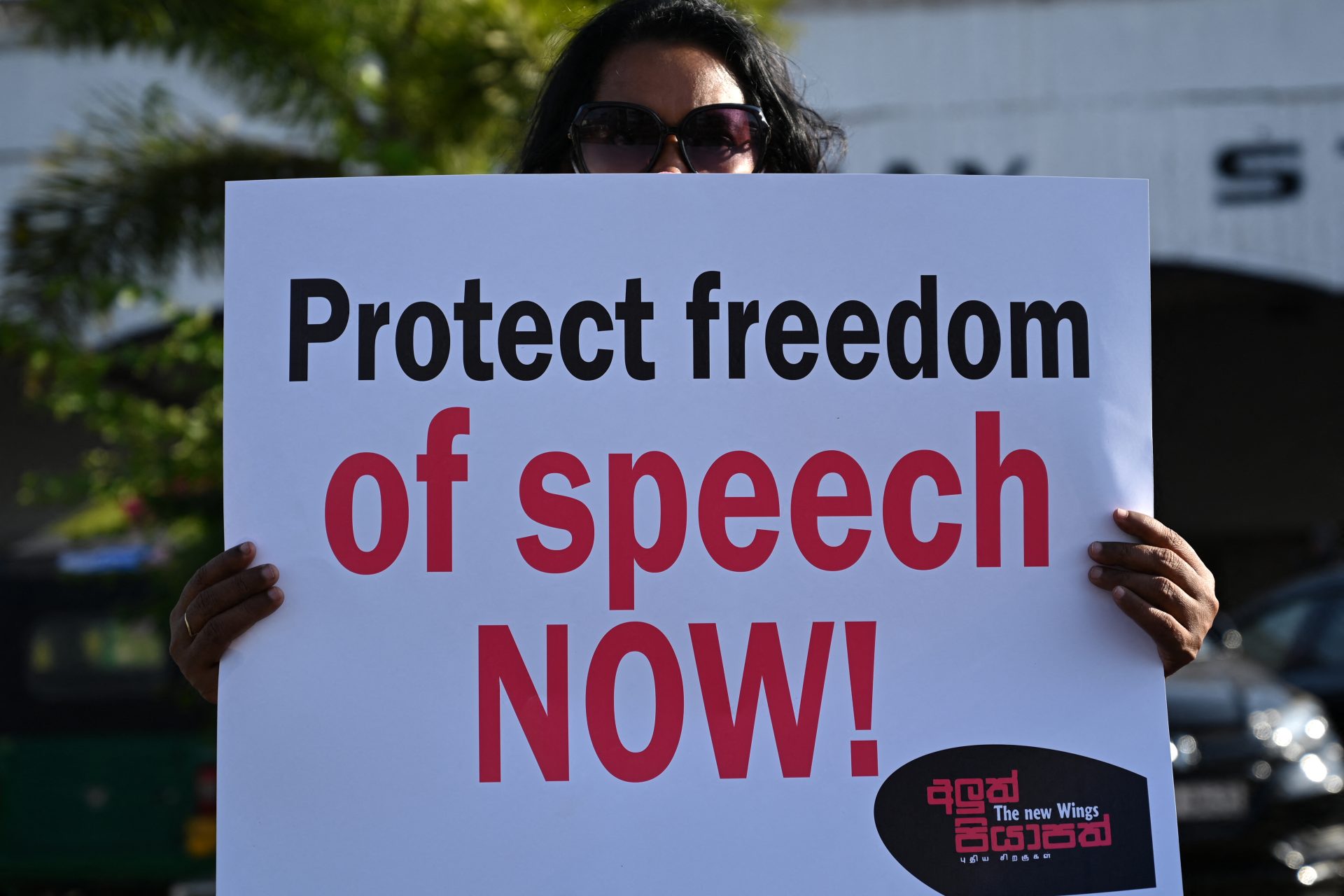
Freedom of Expression and Online Safety in Sri Lanka?

Media Release

February 4, 2026

Freedom of Expression and Online Safety in Sri Lanka

The Federation of Media Employees’ Trade Unions (FMETU) reaffirms its unwavering commitment to the freedom of expression and the right to information, as guaranteed by Article 14 of the Constitution of Sri Lanka. We believe that a robust, independent media—spanning traditional print, broadcast, and digital platforms—is the “Mahagedera” (Ancestral Home) of a functioning democracy.

While we recognize the need to protect citizens from genuine online harms such as child exploitation and financial fraud, we strongly oppose any legislative framework that uses “safety” as a cloak for state-sponsored censorship.

 Concerns Regarding the Online Safety Act (OSA)

Since the enactment of the Online Safety Act in 2024, the FMETU has observed with grave concern the “chilling effect” it has cast over the Sri Lankan media landscape. We highlight the following critical issues:

  • Vague Definitions: Terms such as “prohibited statements” and “false statements” remain broad and ill-defined, allowing for selective enforcement against journalists, whistleblowers, and provincial correspondents.
  • The Online Safety Commission: We remain critical of a Commission appointed solely by the Executive without independent oversight. Such a body lacks the perceived neutrality required to adjudicate on the “truth” of digital content.
  • Criminalization of Dissent: The imposition of heavy fines and prison sentences for online speech—including content that merely causes “moral discomfort”—is disproportionate and serves to silence investigative journalism.
  • Impact on Provincial Journalists: Our members in the 25 districts, who often report via mobile journalism, are now at heightened risk of being targeted for reporting on local corruption or social injustices under the guise of “inciting unrest.”

The Call to Action

The FMETU, in solidarity with the International Federation of Journalists (IFJ), calls upon the Government of Sri Lanka and the relevant Ministry of Mass Media to:

  1. Immediate Reform: Amend the Online Safety Act to bring it into full alignment with international human rights standards, ensuring it cannot be used to suppress legitimate news reporting.
  2. Ensure Judicial Oversight: Strip the Online Safety Commission of its quasi-judicial powers and ensure that any restrictions on speech are handled through an independent and transparent judiciary.
  3. Protect Media Workers: Cease the use of the CID and other investigative bodies to harass journalists for their social media activity or digital news broadcasts.
  4. Promote Self-Regulation: Support a framework of media self-regulation and digital literacy rather than punitive legislation to combat misinformation.

 Our Commitment to the Future

The FMETU will continue to empower its members through training in digital safety and legal literacy. We stand ready to provide legal assistance to any member of the media fraternity whose rights are infringed upon by the overreach of the OSA.

“Information is a public good, not a state-controlled commodity.”

Thanking You,

Tharindu Uduwaragedara                                                                                      

General Secretary

Tharindu Uduwaragedara                                                                                                              
General Secretary

 

Sri Lanka: Police harassment signals growing threat to freedom of expression

Sri Lankan authorities have intensified a crackdown on media freedom through the unlawful summoning of investigative journalist Tharindu Jayawardena and a police request to revoke the broadcasting license of the Hiru Media Network. The International Federation of Journalists (IFJ) joins its Sri Lankan affiliates, the Federation of Media Employees’ Trade Unions (FMETU), Free Media Movement (FMM), and the Sri Lanka Working Journalists’ Association (SLWJA), in condemning these attempts to suppress independent reporting and calls on the National People’s Power government to cease its use of the police as a tool for political repression.

On December 26, 2025, local police summoned Jayawardena, a journalist and member of the Human Rights Commission of Sri Lanka’s (HRCSL) Sub-Committee on Freedom of Expression, to Gampola Police Station to provide a statement regarding his investigative reporting into fraud and corruption at the Ambuluwawa Biodiversity Complex. The inquiry stemmed from a complaint alleging Jayawardena had made ‘defamatory remarks’ regarding the misuse of public funds in his reporting.

In a landmark statement released on February 3, the HRCSL expressed “deep concern about emerging threats to freedom of expression in Sri Lanka”, and identified the summons as a direct breach of a circular which requires officers to provide clear reasons for any legal notice. The HRCSL said police have “no jurisdiction whatsoever” to investigate defamation claims, which are exclusively dealt with by civil courts since the Penal Code was amended in 2002.

The same week on December 24, police also requested the country’s Telecommunications Regulatory Commission to revoke the broadcasting license of the Hiru Media Network, following its coverage of an Embilipitiya cannabis raid, which included allegations of a police assault and ties between the plantation’s ownership and individuals linked to the NPP administration. In a formal response, the network rejected the police claims as a ‘serious threat to media independence’, stating that the footage in question was verified evidence.

These incidents come amid increased criticism of Sri Lanka’s controversial Online Safety Act (OSA), passed in 2024, in the lead-up to the March 5 local and provincial elections. The legislation, allegedly designed to regulate online content and enhance user safety, has been condemned by international watchdogs, including the IFJ, for its potential to challenge constitutional rights protects with the HRCSL, noting it fails to comply with Supreme Court determinations and is being increasingly used to ‘criminalise’ civil disputes. According to the IFJ’s affiliates, the OSA has created a “chilling effect” across Sri Lanka’s 25 districts, particularly for provincial journalists who report on local corruption. In its statement, the HRCSL recommended a moratorium on the Act’s use, urging political leaders to refrain from filing criminal complaints over statements that do not constitute an offence under Sri Lankan law.

The FMETU said: “The FMETU calls upon the Government of Sri Lanka and the relevant Ministry of Mass Media to amend the Online Safety Act to bring it into full alignment with international human rights standards, ensuring it cannot be used to suppress legitimate news reporting; strip the Online Safety Commission of its quasi-judicial powers and ensure that any restrictions on speech are handled through an independent and transparent judiciary; cease the use of the CID and other investigative bodies to harass journalists for their social media activity or digital news broadcasts; and support a framework of media self-regulation and digital literacy rather than punitive legislation to combat misinformation.”

The FMM said:“The Government of Sri Lanka must give serious consideration to [the HRCSL] statement and to the recommendations emphasised therein. This is a moment in which the accountability of the Sri Lankan government is being questioned. Accordingly, the Free Media Movement urges the government to take immediate steps to implement the recommendations set out in this statement.”

The SLWJA said: “We urge the government to refrain from these shameless attempts to enforce media repression through the expansion of a police-state approach, and instead to create an environment that genuinely protects press freedom, editorial independence, and journalistic ethics in Sri Lanka. Furthermore, we call upon all individuals and organisations who value freedom of expression to stand together against the growing pressure imposed on media freedom in Sri Lanka through repressive laws and state interference.”

The IFJ said: Press freedom cannot exist in a climate where journalists face unlawful harassment and escalating threats from authorities for critical reporting in the public interest. With the local elections approaching, the Sri Lankan government must take immediate action to curb this alarming trend by reforming the draconian Online Safety Act and ensuring the police are not weaponised to silence dissent and independent journalism.”

For further information contact IFJ Asia – Pacific on ifj

The IFJ represents more than 600,000 journalists in 140 countries


Young Journalists and Media Development in the spotlight, Sri Lanka.

Rainbow Institute and Rainbow Resources Lanka Celebrate 15 Years of Impact The 15th anniversary celebration of Rainbow Institute Sri Lanka and Rainbow Resources Lanka was held on 16 June 2025 at the iconic Lionel Wendt Art Centre, bringing together a vibrant community of media professionals, educators, and young change makers.

Palestine: At least 166 journalists and media workers killed in Gaza

[UPDATED 30.05.2025] At least 166 Palestinian journalists and media workers have been killed, several have been injured and others are missing during the war in Gaza. The International Federation of Journalists (IFJ) and the Palestinian Journalists Syndicate (PJS) condemn the killings and continued attacks on journalists. The IFJ calls for an immediate investigation into their deaths.

In such dangerous conditions, the IFJ reminds journalists on the ground to take precautions, wear professional safety equipment and not to travel without their media providing them with all the professional safety equipment needed to cover events. No story is worth the life of a journalist.

Press under Pressure: a study of journalists’ working conditions in Sri Lanka,

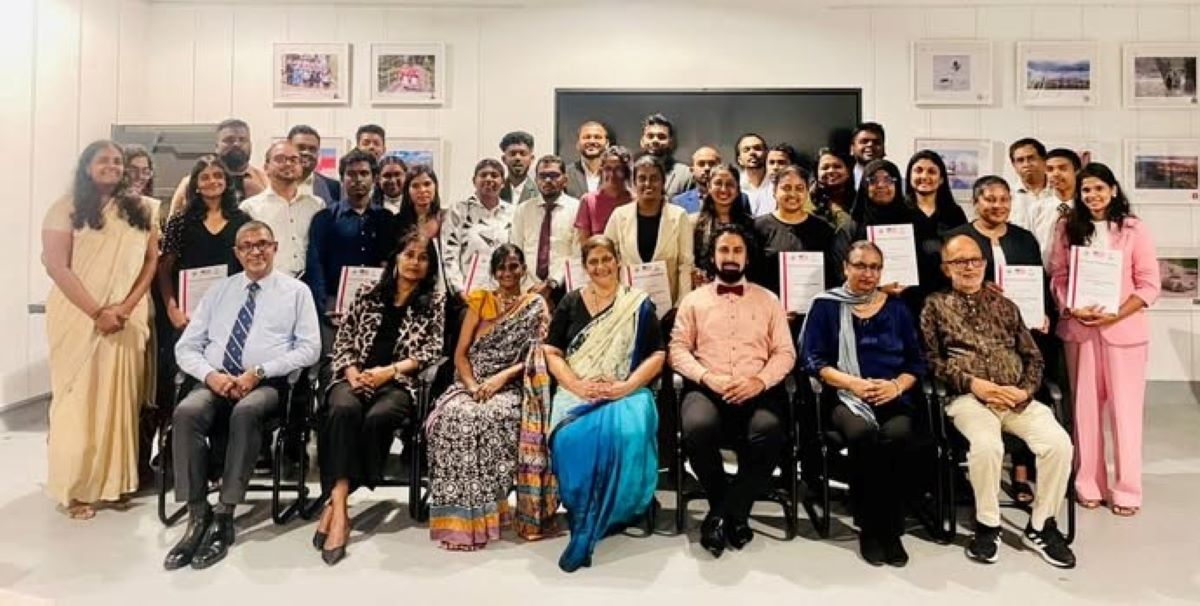
The report, A National Survey of journalists’ working conditions across Sri Lanka”, was launched on 15 May 2025 at Rainbow Resources Lanka. The theme was ” Press under Pressure: a study of journalists’ working conditions in Sri Lanka,” No. 30, Amarasekara Mawatha, Colombo 05. This national survey was conducted by the Federation of Media Employees’ Trade Unions in Sri Lanka, with support from the International Federation of Journalists (IFJ).

The survey sought to expose insights into journalists’ working conditions, challenges, and aspirations across journalists in Sri Lanka.

Commemorate Black January: Honoring the Courage of Journalists Fort Railway Station 2025

How can we forget the individuals who struggled for change, who challenged governments, and who envisioned a better tomorrow? How can we overlook those who sacrificed their lives, faced brutal attacks, endured torture, and suffered countless atrocities simply for speaking the truth?

This is why we call upon all journalists in Sri Lanka and every citizen who dreams of a free, democratic society to join us in commemorating Black January.

An international convention to ensure the safety and freedom of journalists and media professionals!

The International Federation of Journalists (IFJ) has already submitted a draft charter for adoption to the United Nations to ensure the safety and freedom of journalists and media professionals in the next assembly.

The International Federation of Journalists (IFJ) has urged all member organizations to press their governments to adopt this draft, which the Greek government has already ratified and implemented even before the UN adopted the resolution.

The International Federation of Journalists (IFJ) has submitted the draft of this charter to other countries, including Sri Lanka. Sri Lanka’s member unions, the Federation of Media Employees’ Trade Unions (FMETU), the Free Media Movement (FMM), and the Sri Lanka Working Journalists Association (SLWJA), have submitted this drafted charter to the Minister of Foreign Affairs of Sri Lanka. They requested that the Sri Lankan government take necessary steps to give its consent.

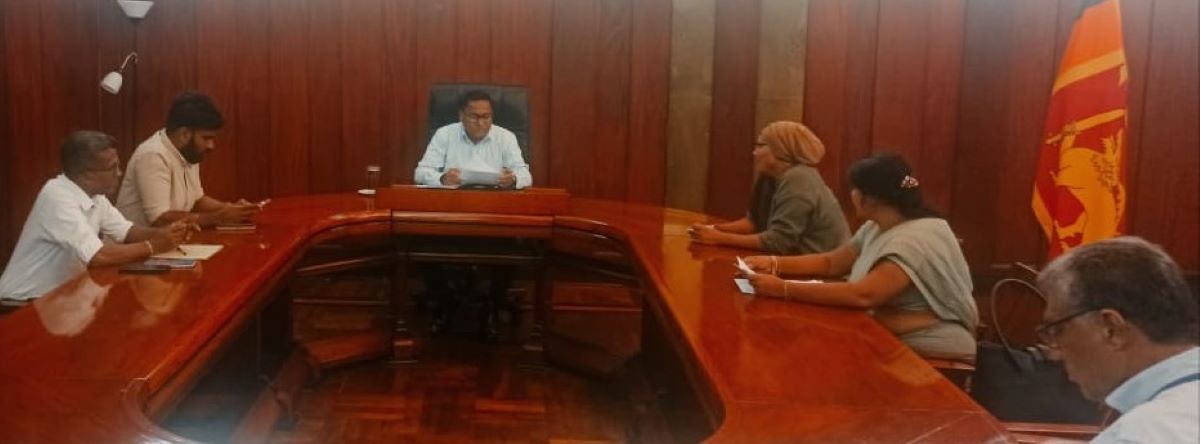
The Minister of Foreign Affairs invited us to a meeting at the Ministry of Foreign Affairs on 21 April 2025 to discuss the matter. The meeting was attended by the Convener of the Free Media Movement, Ms. Hana Ibrahim, Vice President of the Sri Lanka Working Journalists Association, Mr. Pabudu Dushyantha, National Organizer of the Media Workers Trade Union Federation, Mr. Tharindu Uduwaragedara, and Deputy General Secretary, Ms. Indira Nawagamuwa, representing the media organizations.

Minister of Foreign Affairs Vijitha Herath, who entered the discussion in a very cordial manner and expressed his agreement to take necessary steps after further discussions regarding the proposal for a charter on the safety and freedom of journalists and media professionals submitted to the United Nations by the International Federation of Journalists (IFJ) for approval. The Minister of Foreign Affairs expressed his agreement to take the necessary steps after further discussions regarding the support for its adoption at the United Nations.

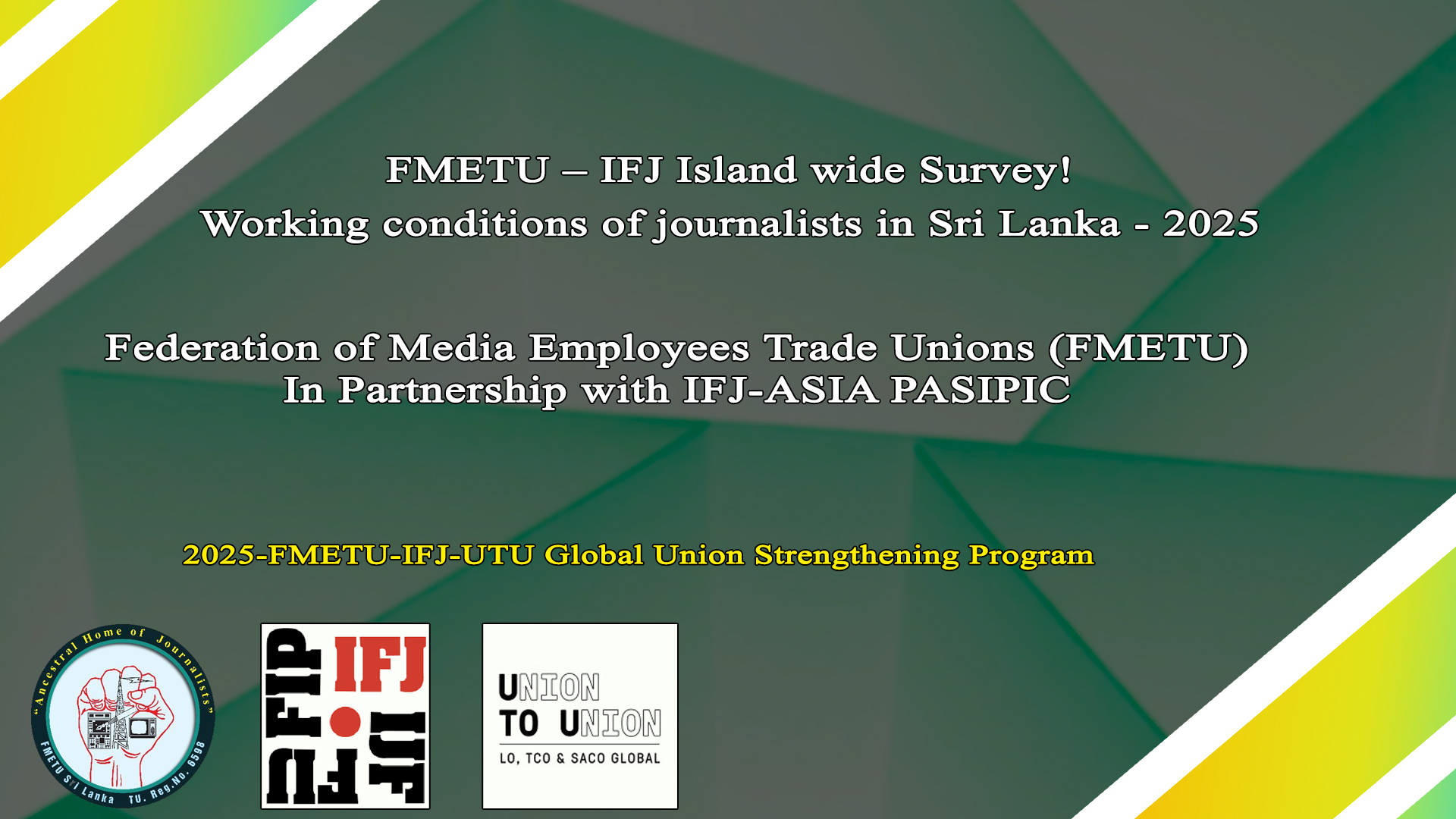
Working conditions of journalists in Sri Lanka – 2025 – FMETU – IFJ – ISLANDWIDE SURVEY

The Federation of Media Workers’ Trade Unions (FMETU), in collaboration with the International Federation of Journalists (IFJ), has begun organizing the proposed Union-to-Union program for 2025.

The Executive Committee of the Federation will hold a preliminary organizational  discussion via Zoom on March 3, 2025. The second discussion will be held on April 6, 2025, and the third discussion will also be held at the Rainbow Institute.

The 2025 program will include a survey on the professional rights of journalists covering the entire island. An online application form is to be designed for this.

“Journalists have a huge role to play as the fourth estate. Journalists in Sri Lanka face numerous challenges as they play their watchdog role to bring critical issues of public interest to the public arena.

The purpose of this survey is to consult representatives from the media and journalist community island-wide to gather information on the status of journalists and their working conditions in Sri Lanka, especially in relation to labor rights compliance.

The findings of this survey will be presented to H. E. the President and other decision-makers, continuing FMETU’s campaign to win better working conditions for Journalists in keeping with international standards and labor rights. ”

The relevant Google Form online link will be provided later.

Do you have questions? Call or visit us.

+(94) 773 641 111

#30, Amarasekara Mawatha, Colombo 5, Sri Lanka.

info@fmetu.org

Newsletter

Get latest news & update

© 2021 – FMETU. All rights reserved.

Carefully crafted by Ceyber Ceylon